

You sat there. You watched evil descend upon your distant neighbours. You folded your arms and watched. Perhaps you even wept: bitterly, helplessly, until the tears dried and there was nothing left in you but the quiet relief that it had not happened to you.
For a few days, life returned to normal. Your smile came back. You went about your business. After all, the past had passed, and today was a brand-new day.
Then it happened again.
This time, the trouble was still aloof. You did not hear the screams yourself. You did not see the blood. You encountered it only on the news: another victim, another family, another tragedy. You mourned, but perhaps not as deeply as before. It was hearsay. Your eyes had not witnessed it. Your body was not there. Soon enough, the news became yesterday’s, and you returned to your ordinary life.
Then, one morning, your colleague arrived at work with a face you could not ignore. His younger brother’s nine-year-old child had been kidnapped and, after an unsuccessful negotiation with the kidnappers, found dead.
You stood there in disbelief, rage and grief. And suddenly you began to wonder: who is responsible for all this? Who is helping these evils survive? Who is fueling the corruption, violence and injustice around us?
And perhaps you wished the answer were somewhere far away.
But what if it isn’t?
What if the answer is closer than you think?
What if, standing before a mirror, you find the answer staring back?
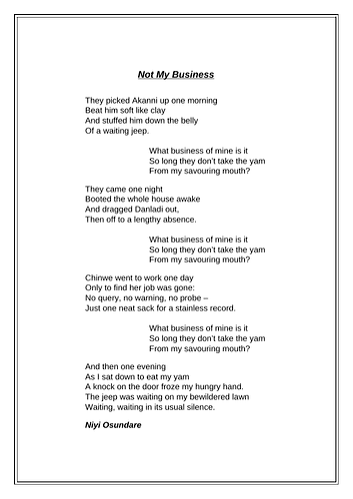
This is the uncomfortable question Niyi Osundare’s Not My Business places before you. At first, the poem seems to be about an indifferent man who watches other people suffer and convinces himself that their suffering has nothing to do with him. But perhaps the poem is not only asking you to judge him; it is asking you to examine yourself.
The persona witnesses violence against Akanni, Danladi and Chinwe, but each time he finds a reason to remain uninvolved. His familiar response is captured in the refrain, “What business of mine is it?” The question becomes his shield. As long as the suffering belongs to someone else, he feels safe enough to continue with his own life.
And this is where the poem becomes uncomfortable.
It is easy to condemn the persona. You can look at him and say, “What kind of person watches these things happen and does nothing?” But as a reader, you are not allowed to remain comfortable for long. The poem posits a more difficult question: have you ever done something similar?
Probably not on the scale of the persona. Perhaps you have never watched someone being dragged away by armed men. But have you ever seen someone treated unfairly and decided that it was not your concern? Have you heard about someone’s suffering and forgotten it because it did not affect you directly? Have you remained silent because speaking up would have been inconvenient, risky or uncomfortable?
This is why you need to see this work from the lens of Reader-response.
Wolfgang Iser argues that reading is not simply a matter of receiving a meaning already sitting inside a text. The reader actively participates in making meaning as the text unfolds. In Not My Business, your response changes as the poem progresses. You begin by observing the victims and judging the persona. You become frustrated by his indifference. You may even feel morally superior to him.
But then Osundare turns the situation around.
The violence that the persona had watched from a safe distance eventually reaches him. The person who repeatedly insisted that other people’s suffering was not his business suddenly discovers that oppression has become very personal. His comfortable distance disappears.
The irony is painful.
His silence did not make him safe.
His indifference did not protect him.
The fact that he refused to concern himself with the suffering of others did not stop oppression. It only meant that he remained quiet while oppression moved from one person to another.
The final image makes the reversal especially powerful. The persona describes a knock at the door that “froze my hungry hand.” The hand that had been reaching for food is suddenly frozen by fear. The man who had been comfortable while others’ suffering is now the one waiting in uncertainty.
And here the poem turns its attention toward you.
Why do you often care more deeply when injustice happens to you than when it happens to somebody else?
Why must a problem enter our homes before we recognise that it is a problem?
Why do we sometimes need to become victims before we become concerned about victims?
Osundare’s poem suggests that this way of thinking is dangerous because society is interconnected. The suffering of another person may not be happening to you today, but that does not mean you are permanently protected from it. More importantly, allowing injustice to continue simply because you are not its immediate victims creates a society in which nobody’s security is guaranteed.
This does not mean that every person who remains silent is automatically as guilty as the person committing the wrong. People may be afraid. They may lack the power to intervene. They may not know what to do. These realities matter.
But there is another kind of silence: the deliberate decision to look away because someone else’s suffering is considered irrelevant.
That is the silence Osundare challenges.
The danger is that one person’s silence may seem insignificant. But when many people keep saying, “It is not my business,” silence becomes a culture. In such a culture, wrongdoing can continue without resistance, victims can become isolated, and injustice can gradually become normal.
This is why Not My Business remains so unsettling. The poem does not simply tell you that oppression is bad. You already know that. Instead, it asks what happens when ordinary people decide that oppression is somebody else’s problem.
The title itself becomes a challenge: Not my business!
But when does another person’s suffering become our business?
Perhaps the answer is: when we recognise that we live in the same society.
You do not have to wait until violence reaches your home before you condemn it. You do not have to wait until corruption affects your families before you speak against it. You do not have to wait until your friend becomes the victim before you decide that injustice matters.
There are, of course, different ways to respond. Sometimes it may mean speaking. Sometimes reporting. Sometimes supporting a victim. Sometimes refusing to join a conversation that dehumanises another person. Sometimes simply refusing to look away.
The important thing is that concern should not remain an emotion we feel briefly before returning to our lives.
The persona in Osundare’s poem saw suffering, but he allowed himself to remain unchanged by what he saw. That is his failure.
And perhaps that is the mirror Osundare holds before you.
You may not be the murderer. You may not be the oppressor. You may not have the power to solve every problem around you. But the next time something wrong is being done to your neighbour, ask yourself what your silence will mean.
Ask what your indifference permits.
Ask what becomes normal when good people continually look away.
And before you say, “It is not my business,” remember the persona of Osundare’s poem.
His mistake was not simply that evil existed around him.
His mistake was believing that he could remain untouched by it.
The poem has ended.
The mirror, however, remains.
And perhaps the most important question is no longer what happened to the persona.
It is what you will do the next time the suffering belongs to somebody else.





1 comment
What a masterpiece!
Indeed, change begins with you.(me&us)