

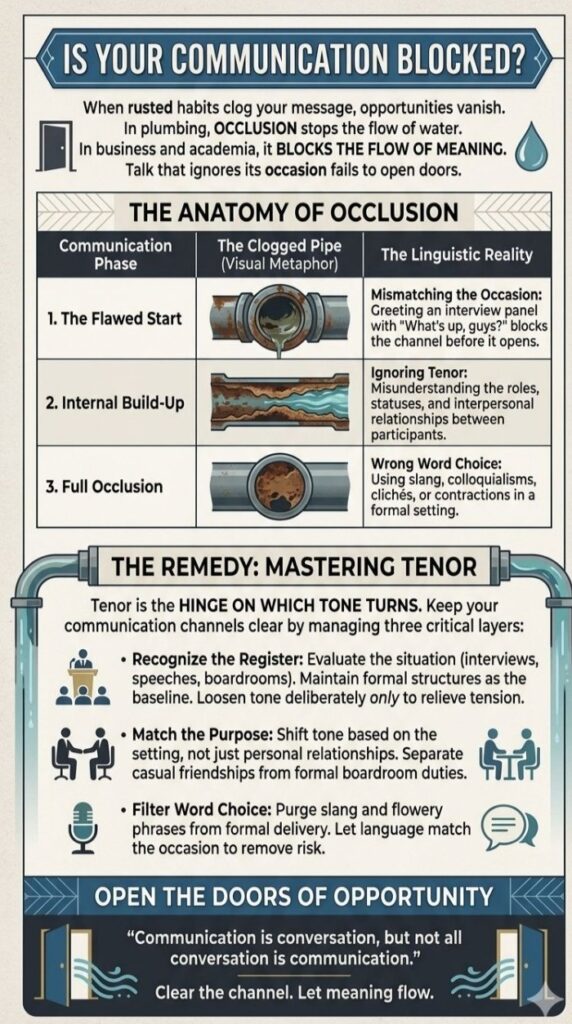
Why Occlusion Occurs in Communication
Occlusion is a scientific term describing a blockage in the flow through a pipe. Communication, too, is designed to be a flow — an unbroken passage of meaning between participants. When that flow is obstructed, occlusion has occurred. This is not merely a linguistic inconvenience; it has real consequences. Many doors of opportunity have been shut against otherwise qualified people, and access to professional spaces denied, simply because of ignorance of the tenor of discourse. The relationship is direct: the less a speaker understands tenor, the more likely their communication is to be occluded.
Consider a job candidate who greets an interview panel with “What’s up, guys?” or peppers a formal presentation with slang. However confident or capable they are, the mismatch between their language and the occasion can cost them the opportunity — not because their ideas are weak, but because their words have blocked the flow of communication before it began. This is occlusion in practice, and it is preventable.
The remedy begins with mastering the tenor of discourse. In linguistics, and specifically in Systemic Functional Linguistics, tenor refers to the roles, statuses, and interpersonal relationships between the participants in a communicative event. It governs the formality or informality appropriate to that event. In settings such as interviews, official speeches, inaugural lectures, organisational conferences, public lectures, and academic programmes, tenor is typically formal — though skilled communicators may deliberately loosen it at moments to relieve tension or boredom. Recognising which register a situation calls for is the first step toward keeping the channel of communication open.
Tenor, in turn, determines the mood and tone of communication. Because a communicative event’s purpose shapes its degree of formality, that same purpose shapes how participants speak to one another. Two business moguls who are also close friends chatting over lunch will speak informally, in a warm, conversational tone. Put those same two people in a boardroom, and the tone shifts — not because their relationship has changed, but because the purpose of the interaction has. Tenor is the hinge on which tone turns.
Finally, tenor dictates word choice. Words are never chosen in isolation; they depend on the context in which they are used. Slang, colloquialisms, clichés, flowery phrases, and contractions are welcome in informal exchanges but out of place in formal ones. A speaker who grasps this distinction — who reads the room and matches language to occasion — removes the risk of occlusion and lets communication flow without obstruction.
Communication is conversation, but not all conversation is communication. Talk that ignores the tenor of its own occasion may fill the air, yet still fail to open the doors it was meant to open.




Comments