

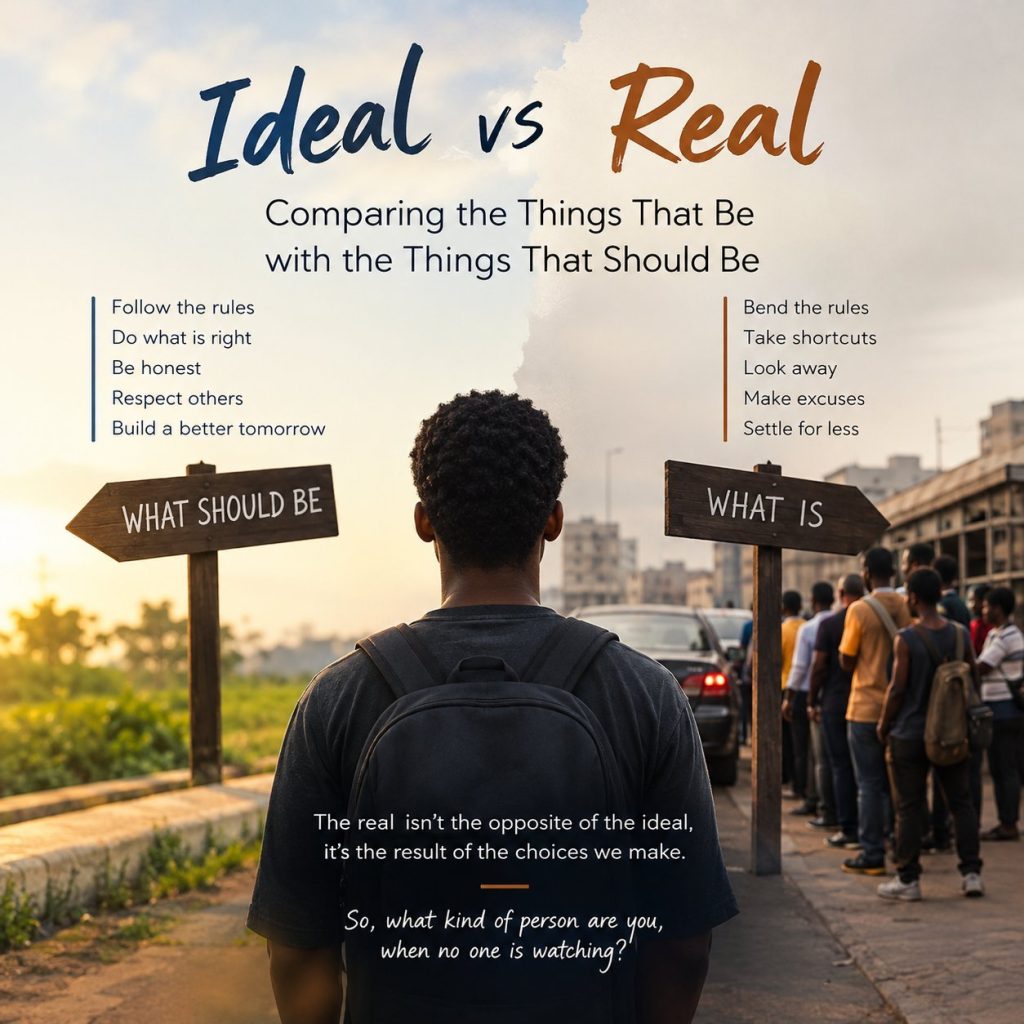
We often say that rules are meant to be followed. But actually (in real sense), especially in this Western part of the World, is it so? In a world where corruption and indiscipline thrive, the line between the ideal and the real is becoming increasingly blurred. We know what should be done, yet we repeatedly find ourselves doing the opposite. We preach honesty but celebrate dishonesty when it favours us. We complain about disorder but sometimes become the very people who create it. Somewhere between what we believe and what we practise, something has gone wrong.
Think about it. Someone jumps a queue because they are in a hurry, another bends a rule because nobody is watching, and someone else tells a lie because the truth seems inconvenient. Yet, when they experience the same treatment from others, they are quick to protest. Isn’t it strange how easily we recognise injustice when we are its victims but struggle to recognise it when we are its perpetrators?
I have had moments when I watched people disregard simple rules as though they were mere suggestions. What struck me was not always the act itself, but how casually it was done. If anyone dared to complain, the response was often something like, “Is it not in Nigeria?”, or something like, “Everybody does it.” I have also found myself in situations where doing the right thing required more patience than taking the easier route. Those moments remind me that it is easier to criticise the world than to examine our place in it.
Perhaps our greatest problem is not that we do not know what is right, but that we have learnt to excuse what is wrong. We call it being smart when we bend the rules to our advantage. We call it survival when we take shortcuts. Gradually, what should be unacceptable becomes normal, and what should be normal begins to look foolish.
Of course, not every rule is just, and blind obedience is not always a virtue. Some rules deserve to be questioned. But there is a difference between challenging injustice and disregarding a fair rule simply because it does not serve our interests.
The ideal represents what should be; the real represents what exists. The troubling part is how often we allow the real to redefine the ideal. Instead of correcting our behaviour to match our principles, we lower our principles to accommodate our behaviour.
Perhaps change begins when we stop asking only why others refuse to do what is right and start asking whether we are willing to do it ourselves. Not because someone is watching, not because there is a reward, but simply because it is right.
After all, what is the point of believing in a better world if we are unwilling to practise the values that would make it possible?



Comments